

Listen to the Podcast:
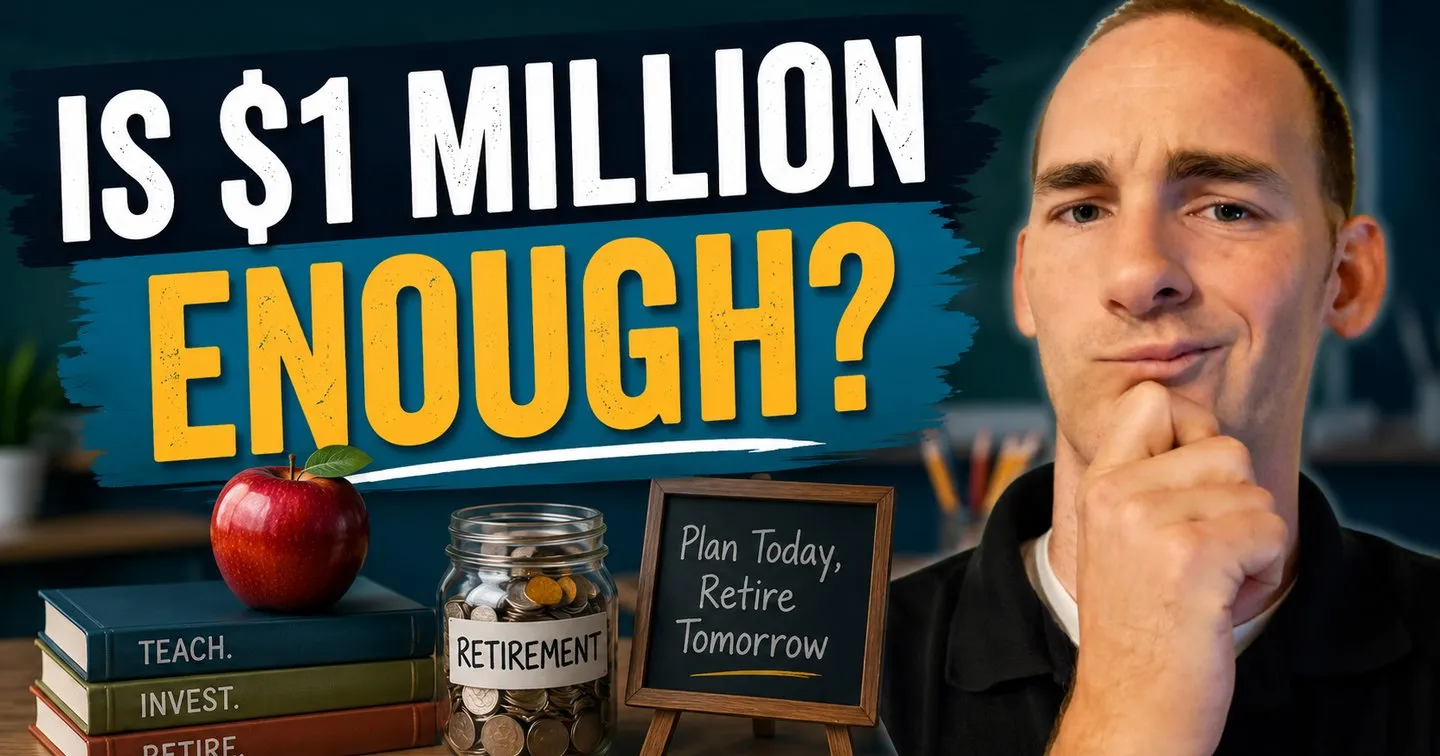
In this episode, I share how you can know when you have enough money to retire. And $1 million is probably not the answer.
Retirement may seem far away or looming large in front of you, but either way the question remains, will I be ready? Will I have enough to retire? And, as with all important things in life, the answer is, it depends. I can’t give you a one size fits all answer, but I can tell you how to discover the answer for yourself. That’s what we discuss in this episode!
Show Notes
The Teacher's Roadmap to Financial Confidence — a free five-question worksheet for teachers who want greater financial confidence
Teacher Money Show Pension Calculator
Free Spending Tracker Spreadsheet
My Budget Coach - Build a 0 based budget with me to coach you!
Compound Interest Calculator
Recommended Books (Amazon Affiliate Links)
How to Adult: Personal Finance for the Real World
Key Ideas
There is a right way to calculate how much money you actually need to retire as a teacher
Your retirement expenses matter more than your current salary
You must include your teacher pension when calculating your retirement income
Social Security can factor into a teacher's retirement plan
The 4% rule works—and why it doesn't tell the whole story
Investments can help cover the gap between your retirement income and expenses
Dividend income, real estate, and other cash-flow sources can reduce the amount you need invested
A side hustle or part-time income can change your retirement math
Bonus Tip
Here is a bonus tip I didn't get to in the episode.
I know that teachers are used to living frugally. So I just want to add this little piece. If you are worried about having enough money to retire and you are close to retirement, adding more money to your investments is good, but cutting expenses is better. For every $1 you don’t spend you need $25 fewer dollars in a retirement account. You can see how saving $100 a month can add up pretty quickly in terms of less dollars you need to retire!
Transcript
How Much Money Do Teachers Need to Retire?
Transcript: This transcript has been lightly edited for readability. Timestamps and obvious transcription artifacts have been removed while preserving the substance and conversational tone of the episode.How much money does a teacher actually need to retire? That is the question that we're going to be asking ourselves today. And by the end of this episode, you will be able to figure out how much you need to retire, calculate what you will actually have based on your current situation, and know what adjustments to make to obtain your goals. Let's get started.
I'm Shaun Morgan, host of the Teacher Money Show, full time educator and money nerd who is building wealth on a teacher's salary. I can do it, so can you. So if you're a teacher looking for the financial confidence to reach your money goals and live a richer life, you are in the right place. If you like what you hear today, Please remember to subscribe and share it with a teacher friend. Now let's get started.
How Much Money Does a Teacher Need to Retire?
This is probably the number one thing teachers are concerned about with money. Other than low salaries and complaining about that, which, you know, let's be honest, we've got some pretty low salaries for our professional attainment. The question is, how can I retire? When can I retire?
Do I have the money I need to retire and how much is that? That is what we're going to try and unpack today. Now, instead of giving you generic advice, I'm going to try and walk you through how to think about this question because generic advice like using the 4% rule doesn't fully apply to the teacher situation, and it's only part of the picture. Instead, we want to make sure that we have a framework to figure out if we are actually ready to retire.
Now the 4% rule is a shortcut that really answers a different question. That question is simply does my income from my investments cover my expenses? If all of your expenses are covered by your investments or other ways of bringing money in retirement, then you are ready to retire. That's the definition because if you're going to be spending more than you're bringing in, you're going to get into debt if we don't want that.
So that is the key. Will I be bringing in more money than I am spending every single month? So the first step is to figure out what are my expenses.
Start With Your Expenses
Now keep in mind this is not your income, right? That number on your salary schedule is not your expenses. Even if you spend all of the money you have in your bank account every single month, those numbers are not the same. So a lot of people will say, oh, how could I ever, you know, replace, you know, 60, seventy $80,000 worth of income.
No, we are just trying to cover our expenses. I just did an experiment with this and I took the amount of money that I'm bringing home every single month in my paycheck compared to the number on my salary schedule. And my take-home pay is only 68% of my gross salary. Now there's a lot of things going into that insurance is part of that, right?
Taxes are going into that, including income and FICA taxes, which FICA taxes will not be coming out of money that you're withdrawing in retirement. You might be paying some taxes on it, but just something to keep in mind there depending on how you're investing. I also have money going into my retirement accounts, so I am putting a percentage of my salary away every single month into those things, which when you're retired, you're not putting money into retirement accounts, you're pulling money out. So I'm only needing to replace about 70% of my income for my expenses now that is if I'm spending every single dime.
So that's that's a quick shortcut. OK, let's bring the number down from our income to our actual take home pay and then we can break it out even more from there because your expenses, if you're saving anything from the money that you are bringing home every single month, are not the full amount. You know, 68% of your salary, or whatever your number is, is not necessarily how much you're actually spending. And the way to figure that out is to start tracking your spending.
Track Your Spending
This is hugely important. If you do not know the answer to the question, 'How much money am I spending every single month?' you need to. And the way to do that is to track it. Now there are multiple ways to track your spending.
There are online apps. I personally use My Budget Coach and if you go to TeacherMoneyShow.com/recommendations, you can get a link to My Budget Coach where you'll be connected to me as your budget Coach where you'll be able to just ask me questions anytime you have a question about your budget or anything like that. It is a fantastic option if you want assistance with your budget. The My Budget Coach app is a fantastic tool if you like that online syncing with your bank accounts type of process to track your spending.
It's also great for zero-based budgeting. But right now we're just talking about tracking. That is something I recommend. That's something I personally use.
But I also think, you know, if you don't want to be spending the money on it, using a spreadsheet is great. If you're all about that spreadsheet, you can create a budget with a spreadsheet. You can track with your spreadsheet. I even have a tracker that you can use.
Once again, you can go to TeacherMoneyShow.com/tracker and you can get that free spreadsheet if you want to do that instead. And then the last way to do this is just with the paper and a notebook. And I also do this. I have multiple ways of tracking my money but I like the paper because it allows me to feel every time I spend the money and the way that it tracks on my zero-based budget versus attraction of the paper are different.
I like having both because I can put things in the context of a month better on paper. In my opinion. The whole key here is to figure out what works best for you. If going into an app and having everything sync automatically is going to work best for you, then do it.
But if it's like syncing automatically and you're like, 'meh, it's all in there', I don't need to look or you forget about it because it doesn't require daily effort from you, then don't use the app. If the spreadsheet works best for you because you are always on the computer, you're always techie, you're you're using those things and you like it to auto calculate, yada yada yada, then use that. But if you're never going to look at it because it's out of sight, out of mind, don't use the spreadsheet. If paper is what's best for you, because it's right there, you can put a piece of paper on your counter and write down what you spent when you come home from the store.
You write down what you spent done like you've got it. That's great. But if you're like, oh, it's just overwhelming because I, I don't want to have to write everything out. I have to calculate how much I spent.
And it seems like too much. Like if that's overwhelming for you, don't do it. But you must do something. You have to choose a way of tracking your expenses so you know how much you're spending. You cannot know if you're going to reach your goal of retirement if you don't know how much you need in retirement. And you'll need to know how much you're spending to know how much you need in retirement.
Build a Baseline
So choose whatever way is best for you and get started. Now the key here or, or a hang up here is that when you start tracking your expenses, you won't actually know your expense behavior in that first month. It'll take, you know, 2-3, even six months to really get a full picture because, you know, last month for example, I had a major hospital bill that I had to pay. That throws off my spending for the month.
I don't usually spend that much money every single month because I don't have a major hospital bill every single month. But that, you know, way jacks up the amount of money that I spend each month. So you want to get a baseline picture of of what that looks like. And you know, if it's an emergency for like, you know, I need to know this now, I need to work on this now.
And you don't have that tracking data, a shortcut to help you get started. I don't recommend this as like the ongoing strategy moving forward. But if you have those credit card statements or those bank statements, you can get all of them together. Yes, all of them.
Every credit card you have, every bank account you have, every debit card, whatever, everything that is money going out of your pocket, you need to get all of them together. And you would then figure out how much you spent. You can't just do a big conglomerate total. I would recommend breaking it down.
OK, I spent this and it goes in that category, this and goes in that category. And then you total up all the categories because that kind of helps you know where your money is going. And that's the power in tracking your spending because you know where you're spending. And if you discover in this process that you're spending too much, then you know the categories that you can start pulling back on.
So categorizing upfront is absolutely key. So once you have that data, once you know that you are spending $5000 a month, $6000 a month, $4000 a month, $22,000 a month, if you're a teacher spending that much money, oh my goodness! But you know, whatever it is, whatever that number is, then you are able to compare that to how much you're going to have in retirement, how much income is going to be coming in. We're going to talk about figuring that out here in a second.
But if the income coming in is bigger than the money being spent, you can retire no matter what age you are, you can retire if that is the case. So that is really what we are looking at. Do my expenses get covered by my income? So then the question is, how are you going to cover your expenses?
The 4% Rule
Well, there are multiple things that you can think of to cover your expenses in retirement, and multiple things are going to have to factor in because it's unlikely that you're going to use just one. You can invest and withdraw, all right? That's the 4% rule. The 4% rule says that whatever you have invested, you can withdraw 4% of that amount, adjusted for inflation from the year you started to be able to cover your expenses every single year.
And in theory, you will not run out of money for at least 30 years if you do that. So if you have a $1,000,000 invested, you can withdraw $40,000 a year because 4% of 1,000,000 is 40,000. There we go. So that's kind of a classic example.
And that's when you are just investing for, for growth and those growth investments with some bonds in there in, in the traditional 4% rule, like study that that came up with this number, it's a 60/40 split roughly when you're retired, you're able to withdraw that 4% every single year, a 50/50 or 60/40 between the stocks and bonds that you're pointing out is, is just like the lockstep approach used in the study and that's how you came up with that number. But the chances of you as a teacher only having money invested and withdrawing only that money from that 4% and just living off of that are quite low. So that's just one thing to consider.
Other Sources of Retirement Income
In fact, I would actually consider that last because you have other things that are bringing money in. So dividend investing, right? If you have dividends paying out, those dividends that are coming into your pocket are free cash flow, meaning you don't have to sell anything to get them. So that offsets the amount that you need to sell from your portfolio.
Cash flow investing from like real estate properties that you own. You know, I don't recommend this as like the thing every teacher should do. But if you're really interested in real estate investing and you want to get into that and get that cash flow coming in, even if it's something as simple as having an Airbnb in your house, right? That is money coming into your pocket every single month.
And you know, you can have that money coming in and it's cash flowing, and it's money that you can use as part of your retirement plan. So that would offset the amount that you need to have invested, right? If you need, you know, $4000 a month to live and $1000 a month is coming from that Airbnb, you only need that $3000 a month covered by other investments or so forth.
Teacher Pensions and Social Security
And then the same thing can be said for your pension or Social Security, okay. And these numbers, which is very interesting, these numbers are based on your gross salary. So like your pension is not saying, you know, the highest, three highest or five highest years of your net pay. It's the three or five highest years of your gross pay.
And then based on, you know, your state, it's usually between 1 1/2 or 2 1/2% times the number of years of service or whatever. If you're interested in figuring this out, I have a pension calculator on my website, TeacherMoneyShow.com/calculator, and you can adjust it for your state's rules and you can figure out what your pension payout is projected to be. But usually that's gonna pay you between 45% to 75% of your gross pay. If you're getting 75% of your gross pay and you were only receiving an income equal to 68% of your gross pay every single month.
But guess what? Your pension covers everything, right? So you're good to go. You don't need anything else invested.
Now do I think you should only rely on a pension? No, but that's a different can of worms right now. The point I'm making is that is going to offset it. So let's say you have 45% coming in from your pension, but you're only spending, you know, 65% of your current, you know, salary.
Well, that's only 20% in there that you're going to need to cover with other investments. And then if you also have Social Security, especially now that we have that act from the government that allows us to, you know, take both without any significant reduction. You know, Social Security is typically in that 40% range of your salary, maybe even higher because we're generally lower paid relative. But you know, 40% is probably typical for what a teacher would typically end up getting.
You might end up with 40% of Social Security, 45% of a pension. That's 85%. That could be, you know, 20% more of your salary that you were not getting when you were working, right. If you had that 65% or 70%, you know, 15% more, whatever.
The point is that you could be getting significantly more in retirement just between your pension and your Social Security. If you stick it out as a teacher. And then you add on top of that that you have money invested or you add on top of that that you have, you know, an Airbnb in your home and you could be living at a much higher standard in retirement. Now, of course, the pension and Social Security only come into play when you're at that retirement age.
So if you're looking to step away from teaching before you reach, you know, 59 1/2 or something like that, or 55, some, some pensions are that low, then you're going to need to bridge that gap between when you want to stop teaching and when you can start drawing that money. And that's where those investments come into place. But once again, do you see how there's so many different factors here? I can't just say, oh, this is the rule, this is what you do, this is what you have to do. It has to come down to you, what you want, what you are planning on, what your life looks like, what your investments look like, what your pension looks like, your state, the Social Security situation and so forth. All of that plays together to come up with the answer to the question, how much money does a teacher need to retire?
The Role of a Side Hustle
But of course, the generic answer is as soon as you can cover your expenses with your investment or pension or other income like that, then you're able to retire. Now, I'm going to give one more unconventional piece of advice here, and that is a side hustle, a part-time side hustle, something that you love doing that can bring in some money, right? This is not traditional retirement, but a lot of teachers who are really retired end up substitute teaching for just a shamefully low wage. I think substitute teachers deserve way better pay because my goodness, that is a hard job.
But the point is that if you are working part-time, let's say you're bringing in $1000 a month, $2000 a month, and you need $4000 a month. Well, the amount of money that you need in retirement or the amount of money you need to retire becomes less because you're willing to work a little bit, you're willing to get out and do something and make a little bit of money. I generally recommend against the low paying things like just, you know, driving for Uber. But if you really love talking to people and meeting new people, then sure, do that.
Or, you know, you can just do something a lot smaller than that, like building out lesson plans and putting them on Teachers Pay Teachers and then figuring out if that's going to bring in some money. I don't know what you're going to do. It depends on your side hustle desires. And there are so many, and we've talked about so many.
I don't want to give more ideas right now. But the point here is if you're willing to do a little bit of work on the side, maybe build up a little stream of income from a side business, that side business will keep paying you when you are retired. So you don't need to have that much money invested to withdraw from. So, you know, when I was first talking to teachers about this, my first foray into helping teachers with money, I told the teachers that you need 25 times your expenses in investments to be able to retire. And they're like, 'There's no way.' And then it occurred to me in that moment that that is 25 times the amount of expenses that are not covered by other things because teachers have so many other things. So here's my order of operations for thinking about this: Pension, Social Security, those things are going to come in dependably no matter what.
My Order of Operations
You need to think through that and how much they're going to be bringing in. You also should consider a COLA. Is it going to have a cost of living adjustment? If not, you're going to want to be able to cover that.
As the gap gets bigger and bigger and bigger, you're going to want to make sure you can cover that gap with your investments and then look at things that bring in free cash. That's your cash flow investing. If you're interested in it, an Airbnb can be a great way to offset the cost of owning a home, especially as prices on houses just keep going up. Dividend investing is another way of getting free cash flow coming to you every single month that you are not selling things off.
And then like a side hustle, if you want to do it, if you want a side business, all those things are the free cash flow. So let's say between those things, you have $4000 a month in expenses, you've got, you know, $2000 coming from a pension, you got $500 coming from Social Security, you've got $1000 coming from your cash flow, you know, free cash flow things. That's only $500 a month left that you need to have covered. And $500 a month times 12 is $6000 a year.
$6,000 times 25 is really not that much money, right? We've got $6,000 a year. $6,000 times 25 is $150,000 invested. If you do $100 a month for 30 years, that's roughly $150,000 invested at a 10% return, etc. All the caveats there, but that's not very much money to be able to put aside to bridge that gap. All the caveats there, but like that's not very much money to be able to put aside to be able to bridge that that gap.
Putting the Numbers Together
So there is so much we have that are working for us and so much we have to think through. But once you know what you're spending every single month and the ways you're going to be able to bring an income in retirement. Put those together, you'll be able to know if you are ready to retire now. These things are myriad.
There's so many things to put together. You have to put time in there as well, right? You have to say, OK, I'm going to project what my salary will be. I have to, you know, figure out, OK, it says this on my salary schedule right now, but you know, it's going to adjust.
So what will actually be in the future? And there's so many different moving parts here, and it's impossible to get them all right? But you can get at least a decent picture of it as you're thinking through this moving forward. So here's the takeaway.
The Takeaway
Here is the answer to the question, how much money does a teacher need to retire? Ask these questions. How much do I spend right now? How much do I want to spend in retirement?
Will my current investments, pension, Social Security, etc., get me there? Remember, you must project those numbers. So you have to use, you know, the calculator for the pension that I mentioned, TeacherMoneyShow.com/calculator, theinvestor.gov calculator for compound interest. I know compound interest is not really what investments are, but it gives you an idea.
You know, 10% or 8%—if you're being conservative—is generally what you can expect from the stock market, assuming that it continues to do what it's been doing. There's also Social Security calculators. All these things I will post links to on TeacherMoneyShow.com/podcast and you can find the link to the show notes there and you'll be able to get those, you know, calculators to really work through this. But you use those things to figure out where will you be, you know, in 10 years, 20 years, 30 years, whatever your timeline is with these things.
That way you can have that idea in place, and you need to figure out when that's going to make a big difference in this calculation. So that way, you know, where will I be and my current trajectory and if you will make it, if you look at how much you want to spend in retirement and how much you're going to have, great. Just keep doing what you're doing. You don't need to change anything.
But if you're like, OK, I'm going to be, you know, this much money short, then you can calculate how much more you'll need to invest to be able to bridge that difference. Or maybe it's just lowering expenses. I'm spending too much on Amazon. If I just spend less on Amazon, I'll be fine, right?
Whatever it is, there are lots of things that you can do all right, or you can get creative. You can move to another state, whether before or after retirement, because that will change your pension or it will change your cost of living. However it is that you need to approach this is right, as long as you're going to reach your goal. So just get creative, work through this, figure out where you are, where you want to be, will you get there and make those adjustments and you will be ready to retire.
The Teacher's Roadmap to Financial Confidence
If you want help thinking through this question, you can download the Teacher's Roadmap to TeacherMoneyShow.com/roadmap. You'll work through five questions designed to help you gain financial clarity and understand the roadmap for your journey. We all know that we should budget or invest for our future, but until you know what it'll actually take to get where you want to be, it's impossible to move forward. So we're doing things like beginning with the end in mind, backwards planning, starting with the big rocks, whatever you want to call it.
This road map is going to help you to get there. So be sure to download your copy at TeacherMoneyShow.com/roadmap. And remember, as a teacher, you are already rich. Your wallet just needs to catch up.
Disclaimer
If you're a teacher who loves teaching but aren't sure if you can reach your financial goals, I've created a free worksheet called the Teacher's Roadmap to Financial Confidence. Go to TeacherMoneyShow.com/roadmap to get your copy. That's TeacherMoneyShow.com/roadmap. The contents of this podcast are informational in nature and are not legal or tax advice, and neither I nor my guests are engaged in the provision of legal, tax or any other advice. You should not act upon this information without first seeking appropriate advice from an accountant, financial planner, lawyer, or other professional.