
Listen to the Podcast:
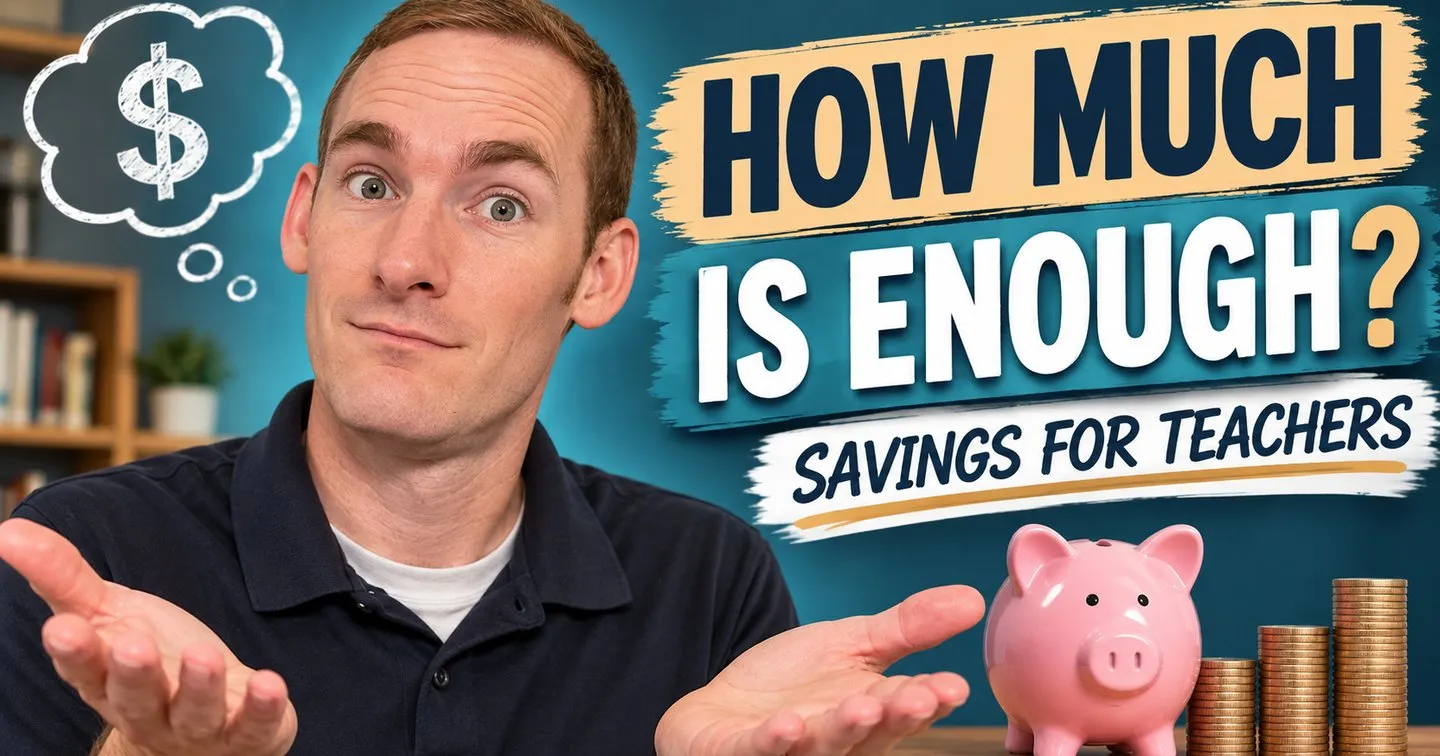
In this episode, I share three reasons to save and how much you should have in each of those buckets.
There are so many competing priorities for your money, investing, saving, paying off debt, and don’t forget enjoying it! While I can’t explain the balance for each of these things in one episode, the item that gets ignored the most is saving. How much should you actually have in savings? Well, let’s find out!
Show Notes
Financial Roadmap Strategy Session - Meet me Shaun to become financially confident!
The Teacher's Roadmap to Financial Confidence — a free five-question worksheet for teachers who want greater financial confidence.
Ally Bank (The only online bank I recommend)
The Bond Ladder Strategy episode (we also discuss Target Date Funds)
Worthy Bonds (My recommended bond product for higher yields)
Recommended Books (Amazon Affiliate Links)
A Teacher's Net Worth Book
Key Ideas
I recommend starting with one month of expenses.
Your emergency fund should be separate, accessible, and reserved for genuine emergencies.
Save for large expenses like a car, home down payment, medical bills, or family vacation without going into debt.
Use a high-yield savings account, CD, or short-term bond for money you're saving (depending on when you need it).
Retirement cash reserves can protect you from sequence-of-returns risk.
Your teacher pension affects how much money you need to keep available in retirement.
A bond ladder can help protect your retirement income during a market downturn.
Bonus Tip
Here is a bonus tip I didn't get to in the episode.
When you think of bonds, you probably are thinking of municipal bonds or treasury bonds. While these are extremely safe, they are also extremely low yield. There is another option! I use Worthy Bonds when I want a bond product. As a private bond their yields rival that of the S&P 500 (about 7-8%) without the ups and downs of the market. So, if you’re looking to implement the bond ladder strategy, or need a good place to store cash for a while, use Worthy Bonds.
Transcript
How Much Should a Teacher Have in Savings? | The Teacher Money ShowThe Teacher Money Show
How Much Should a Teacher Have in Savings?
Episode 133 · Full Episode Transcript
Introduction: How Much Should a Teacher Have in Savings?
How much should a teacher have in savings? That is the question we're going to answer today, and by the end of this episode, you will have the tools to know the exact dollar amount you need to have on hand. Hello, I'm Sean Morton, host of The Teacher Money Show, a full-time educator and money nerd who is building wealth on a teacher's salary. I can do it, so can you.
So if you're a teacher looking for the financial confidence to reach your money goals and live a richer life, you're in the right place. If you like what you hear today, please remember to subscribe and share it with a teacher friend. Now, let's get started.
All right, guys, we're talking everything savings. Now, I've got to be honest with you. You got to be real here.
What Counts as Savings?
I recorded this entire episode already, but didn't record this entire episode. I thought I'd press the button. I hadn't.
So I'm going to do my best here. This is a little disappointing, but we're going to go ahead and dive right in with defining savings. What is it? Now, the reason we got to define this is because as teachers, it's important to define things and because savings has an ambiguous meaning.
It can either mean money not spent or it can mean money held in reserve for a specific cause. Money not spent is not what we're talking about today. Money not spent is your savings rate more than it's just your savings.
It's just comparing how much you spend to how much you've been able to save. Or how much you make compared to how much you've been able to save. That's your savings rate.
And that's just like nebulous savings. I'm not spending this money. And that's not what we're talking about.
Yes, your savings rate matters, but your savings rate plays into your savings and your investing. And we are not talking about investing. Another thing to note is you can't save your way to retirement.
You must invest your way to retirement. Now, you use money that is not spent, right, to be able to invest. So that's why people can talk about saving for retirement.
Building an Emergency Fund
But if you just save money for retirement, you won't ever be able to retire. So just keep in mind that the definition we're talking about today is not saving for retirement or your savings rate. We're talking about money held in reserve for a specific cause.
That is what we're trying to figure out. How much money do we need to have in reserve for a specific cause? Well, there are three specific causes that you will probably need to have money held in reserve for. An emergency fund, large payment fund, and then cash reserves.
And we'll talk about each of those and why they matter and when to use them and how much you want to have for all of them. So let's start with an emergency fund. An emergency fund is money to have on hand in case of an emergency.
It's money that you can use when something happens like a medical emergency, a car insurance bill needing to be paid, like the deductible needing to be paid. Or let's just say that your car breaks down and you need to repair it. Or you have to suddenly take a trip to go visit your parent who got sick, right? Whatever it is, that's an emergency.
You use the money for the emergency. Now, the way you think about it though is the emergency can be anything. So how do you figure out how much you need? Well, generally speaking, in the event of an emergency, you need to have money on hand to cover your basic expenses because you're not going to be working the way you usually would be working, or you are going to be disabled in some way, or you just need a large chunk of cash on hand to cover those big expenses as they come up.
So conventional wisdom says you need to have three to six months of your monthly expenses. Notice this is not the same thing as the income, right? You are not doing three to six months of income. It's your expenses.
Because if you make $6,000 but only spend $3,000 a month, then that's going to be a large difference in the amount of money that you need on hand. And we don't want to have too much money in the emergency fund. And the less you can spend, the more you can bring that number down on your spending, the less money you'll need in that emergency fund because you can last longer on less money, if that makes sense.
So that's the idea. Three to six months is the conventional wisdom. But I say that that's a lot of money.
Let's say you're spending $3,000 a month. We're talking about $9,000 to $18,000. I mean, that was half of my paycheck my first year of teaching, a little more than half, right, for $18,000.
So that's a lot of money for a teacher to just have on hand. And if you've prioritized putting three to six months aside before you do anything else, you're going to spend a lot of time not doing anything else. So we need to make sure that we are being realistic.
And then the other extreme is to say, well, just put $1,000 to the side. And that's the beginning of your emergency fund. I agree with that.
But $1,000 doesn't go as far as it used to. Most of my deductibles are much bigger than $1,000. So it wouldn't be extremely helpful to just start there.
I mean, if you only can get $1,000 on hand at first, you know, aim for that. But I think the sweet spot is to start with one month of expenses. And the reason I think this is because especially as a teacher, you are highly unlikely to lose your job, like highly unlikely, unless you're doing something illegal, which by the way, if you're doing something illegal, get out.
You're not going to be kicked out because you're underperforming, right? They're not going to be like, well, we've got to make some adjustments, and you're going a different direction. None of that kind of thing's happening. They're going to keep you at least till the end of the year.
And then they'll be like, we're going to find somebody else. And you'll probably get told that in May. And then you'll get paid a couple of months in the summer, assuming that you are on one of those 12-month calendars.
So you have time to adjust and to adapt. It's pretty difficult to fire a teacher. So I think that we're pretty good.
The only reason that you might have some sort of an emergency where this would not be the case, if you are in a place where you can't work anymore, in which case there's often short-term disability, check your benefits, maybe even long-term disability with your benefits. And if it's really, really bad, then governmental disability takes over. So the space, that gap between it's a big enough emergency that I need a bunch of cash on hand, but it's so big that I can't work anymore, is pretty small for teachers.
So that's why I say one month is a very good place to start. Because if for some reason you're not bringing in a paycheck for a month, you're able to cover that. But it's also probably enough money to cover a large deductible or to cover a big, expensive plane ticket and hotel if you need to go stay because one of your family members is stuck somewhere in a hospital or whatever it is.
Like there's lots of different things that could happen. But this amount of money is going to cover those things. Now, that doesn't mean that I'd say just stay there.
I think having a larger emergency fund is a great idea. Build towards that three to six months. Just don't put a pause on everything else while you get there.
And then once you got three to six months, if you're still like, I feel antsy, I'm not sure. Having three to six months of expenses, plus all of your deductibles on hand is more than enough in my opinion. Because in the worst case scenario, where you lend your friend a car and they are driving that car back to your house, the gas pedal gets stuck, they drive your car into your house and knock you over breaking all the bones in your body.
Your car is totaled, your house is wrecked, and you've got a major hospital bill. You're going to have to pay all of your deductibles all at once, right? That is the worst case scenario. And then you have three to six months of expenses on top of that to help cover things while you are recovering.
That is a really, you know, terrible scenario that you'd be prepared for. And I can't imagine anything being worse than that money-wise. So that's really what we're aiming for, to be able to cover with a fully funded emergency fund.
But that's a very large number, like really large. I'm talking about like, you know, $50,000 or something like that to cover, you know, three to six months plus, you know, covering all those deductibles, like, you know, the out-of-pocket maximum for your health insurance. Like that's a ton of money.
So it's very important that you don't focus on doing just that. It's important that you, once you've reached a milestone, such as one month of your expenses, you start investing. And you start looking at these other saving options that we're going to be talking about, because you don't want to miss out on those opportunities.
So first thing, one month of expenses. How much is that? I can't tell you. That's up to you because I don't know what your expenses are, but I'm giving you the tools to calculate it.
So let's start there. And then you can also adjust to three to six months or to three to six months plus a deductible, depending on where you are on your journey. Those are the tiers that you're going to be able to calculate how much you want to have in savings.
A few things to note about your emergency fund. You want to keep this as liquid as possible. You don't want this money to be stuck in something that if you pull it out, you get a 10% penalty because you need the money now.
It's for an emergency. You don't know when it's coming. So I'd say keep it in cash.
I personally use Ally Bank. I recommend them not because I'm like an affiliate with them. Maybe like I think on teachermoneyshow.com slash recommendations, you can find a link that will help you sign up and get like a bonus or whatever.
It's like a friend referral link. But I just really like them because I use them, right? I use them because they've got great customer service. They pay great interest rates and they're easy to use.
All around happy with Ally Bank. And it allows me to keep the money in a separate place. It allows me to separate my emergency fund from my everyday fund.
So that way I'm not tempted to use it willy-nilly, right? It needs to be a genuine emergency for me to use it. Now on the flip side, if I'm trying to build my emergency fund and an emergency happens, use the emergency fund. Don't prioritize building that emergency fund over paying for an emergency.
Like if you're gonna use a credit card so you can build your emergency fund, don't do it, right? It makes way more sense to use that emergency fund. That is what it's there for. But keeping that separation so it's not like, oh, well, I really need a new pair of shoes and that's an emergency.
Like, no, like keep it separated. So that way you're not tempted to use it unless you absolutely need it. And that is just a good practice for most of these things.
So we'll talk about that principle in a couple of different places. Now, what I like to do is focus primarily on the emergency fund upfront. You are building that up, right? And then once you've got that minimum amount that you want, that one month that I've talked about, then you can continue keeping a small portion of funds going to that.
I think that it's important to always be kind of growing that emergency fund because emergencies will happen. If you're continually just putting $50, $100 into it and then an emergency happens and you pay it down, well, you still have that minimum, right? And if you go below the minimum, focus again in on building up at least the minimum, right? And then once you've done that, you can turn on the valve to other options, other savings or investing. I recommend putting on investing.
Saving for Large Expenses
We'll talk about that later. So that way you can start growing your money at a faster rate. And you can build that out of your emergency fund.
So you have money come into your main account. And then you automatically move money into your emergency fund, or you split it and you have your paycheck just automatically part of it go to your emergency fund. And then when you have that going how you want to, you turn on the valve that goes into your investments, into your other savings.
That way it's all coming out of that point. So it's kind of just like flowing and rolling down from your main account. I think that's just an easy system to think about.
So you're only having to turn on and off, you know, an amount of money that's coming out of one account at a time, and you can just kind of divert it where it needs to go. And I just have to say this once again, because this is important. Don't be afraid to use your emergency fund.
That is what it's there for. We're just talking about how much you want to have on hand, but you don't want to sacrifice, you know, paying for that emergency just to keep that money on hand. You can replenish it after you use it.
So once again, recap, one month of expenses, next year, three to six months of expenses, next year, plus your deductible. That is what you want to have on hand for emergency fund. Now let's move into the second reason that you'd want to have money in savings, and that is saving for a large payment.
Whatever this large payment is, is up to you. Whether it's a car purchase, a home down payment, an upcoming medical procedure, or a good old family vacation, there are lots of reasons to save money beyond an emergency fund. Lots of reasons to have money in cash.
We're not talking about investing right now, money in cash. Now, this is different than an emergency fund because you have a distinct reason and cost associated with that reason that you are saving for. So it gives us a different strategy for building up this fund.
Instead of just having a nebulous, I need this money at some point, in case an emergency is coming, you have a very specific goal and timeline. So you say, hey, it's going to cost me $12,000 in two years to purchase a car, so I need to save $500 a month every month between now and the next 24 months. That way I'll have that $12,000.
Do you see how that's a very specific amount because you have a goal that you're working towards and you can set aside the money to get there. Now, you don't always make it. Sometimes you just can't put that money aside because other things come up, like an emergency, you have to re-divert that money, right? So it's important to make sure that you're being a little flexible with this.
You can increase the amount you can put towards it later, or you can stretch out the timeline, or you can just reduce the cost. Say, I'm going to go on a smaller vacation or get a cheaper car because I really need it right now. And this is what I have on hand.
Those kinds of things are the way you can do with this, but saving towards it is what's going to allow you to make those flexible decisions. Because if you don't, then you're going to get debt to do these things and debt, of course, is just going to absolutely wreck you. So do not get into debt over these things as much as possible.
That's what we're saving for, to avoid debt when we get a used car, not a new car, in my opinion. Go on vacation. People that swipe a credit card, go on vacation.
It sounds like fun until you realize that all that credit card debt follows you as soon as you get back home. And reality is even less fun after you get back. So nice.
It's so nice to have money saved for a vacation. So you can just spend it confidently. Now it's important to keep this money separate.
You want to keep this money separated, not only in your zero-based budget. So that way there's like a whole category for it. So you can track it there, but also in a separate bank account, like we talked about with your emergency fund.
Retirement Cash Reserves
And I would recommend a separate bank account from your emergency fund. They allow you to do buckets and things like that in accounts now, but having it in a completely separate account allows you to look at it and then see it at a glance. And it's not like they're charging you more money to have another savings account.
If they are, get a different bank, because it's just, it's easier to say, this is my savings for a large payment account. This is my emergency fund account. And there, the two shall meet.
Like you don't say like, well, it's not an emergency, but I'm going to buy a car. So I'll just, you know, take a little bit extra so I can buy that, that nicer truck, right? You don't want to do that. You have only what you have saved for your emergencies and only what you have saved for your large payments because there are different purposes.
You don't want them to be conflated. And then another reason to do that, to separate them is because they don't have the same liquidity requirements. Your saving for a large payment account doesn't have to be accessible now.
If you need something in two years, you can put it into an 18 month CD because you don't need that money. So it can increase the interest that you receive on that money or even a short-term bond can work for this. If you have a distinct timeline and you can find something that increases your yield for a short time, a time shorter than that timeline, then, then go for it because this money does not have to be available right now.
So that is how savings for a large payment differs from an emergency fund. Now let's look at the third, which is cash reserves or retirement cash reserves. The retirement cash reserve is very similar to emergency fund, but it also has some of the mechanics of a regular savings.
So what is this? Well, the idea here is you can retire and the next day the market crash. That is not good for your investments. If you are pulling money out of your stocks at a discount, at a discounted rate, basically, then you are pulling a relatively larger chunk of your portfolio out in terms of number of shares to pay for your lifestyle, as opposed to all the shares are going up in value.
So to avoid this thing called sequence of returns risk, you can have a reserve, a cash reserve on hand that if the market crashes in those first five or so years after retirement, that you are able to be able to pull in those cash reserves. So that way you don't have to draw down your stocks. It's just a powerful strategy to really hedge against your stocks dropping in value.
Now, there's a few things to keep in mind as a teacher when you're doing this. First of all, you only need as much as the gap between your pension and your expenses, because your pension is not going to change even if the market crashes. So if your pension is, you know, $2,500 a month and you spend $3,000 a month, you only need to be able to cover $500 a month or $6,000 a year with this cash reserve strategy to be able to avoid that risk that we're talking about.
So it doesn't have to be huge, but if you don't have a pension or your pension is really small compared to your expenses, then of course you need to have a larger amount. And this is going to be something like a year of expenses. I mean, technically five years is best.
And we'll talk about a way to do that. But, you know, at least a year of expenses if you're trying to be extra cautious and extra careful with your retirement, because that year gives some time for the market to recover. It probably won't come all the way back up, but usually the market starts to bounce back after a year, usually.
Past performance is not indicative of future results, yada, yada, yada. But the point is that historically speaking, the worst happens and then, you know, it comes back up and after that year, you'd be able to start recovering. Now, if you want to cover this five-year period, then you start planning in advance.
Remember, you have this specific number in mind. I need this much money, right? You know what the gap is between your pension and your expenses. And then you have a timeline.
I'm going to retire in the next five years. I'm going to retire in the next 10 years. And you build towards that goal of having that much money in your account to cover those expenses.
Now you can do just like a raw cash amount of, hey, I need one year. That's like the minimum version of this. So it's going to say, let's go with the 6,000 example.
I need $6,000 to cover that gap for one year if the market crashes. So that's what you are saving for over those five or 10 years. Then the next level up is you can build the five-year ramp.
If you're five years out or 10 years out, it'll change your perspective. I wouldn't start this much earlier than that for retirement. It's unnecessary to have it on hand that early.
But if you're, say, 10 years out, you can put money into a 10-year bond because bonds are going to usually move inverse of stocks. So you don't have to worry about your bonds dropping in value, usually when the stocks drop in value. So that gives you power when it's time to pull that money out.
And you have that bond. It's been 10 years. And boom, it's now liquid, ready for you to use the year that you're going to retire.
The next year, you do another 10-year bond. So you have that second year. Then another third year, another fourth year, another fifth year, right? That gives you money on hand to cover that first five years.
How Much Should You Keep in Savings?
Now, you might not be able to cover that whole $6,000 with that bond depending on how much money you can put aside. That's where that second layer comes in, that five years out. Then you do a five-year bond and another and another and another.
And you now have a 10-year and a five-year bond that's maturing at that year that you are retiring and the next year and the next year. I learned this strategy on a previous episode here, and I'll link to that episode in the show notes at teachermoneyshow.com slash podcast. You can find the show notes for this episode or any episode there, or you can look in the description on the show notes for that direct link.
But this thing called a bond ladder just allows you to hedge against those drops in that first five or 10 years, but five years really, of retirement. Because if the market grows during those years, then you're probably set. And if it drops, then you have those bonds to kind of protect you along the way.
And then you can just kind of keep reinvesting those bonds into another five-year bond until you need them in the event of a crash. And it's just a powerful way to keep money on hand that's not going to drop in value as much as stocks are in the event of a crash. So that's kind of the idea here.
And once again, because this does not need to be liquid, I really don't recommend keeping this in cash 10 years out. And you're just, you know, stocking money away in cash. Putting it into bonds or putting it into CDs at the least to allow it to grow hopefully faster than inflation is powerful, but just don't put it in stocks because that would defeat the entire purpose.
So that is the retirement cash reserve. So the amount that you need on hand depends on that gap between your pension and your expenses for a year to five years. So to recap the expenses, how much money do you need to have in savings as a teacher? Depends on where you are, who you are, right? But start with that emergency fund.
The Order of Operations: What to Fund First
Start with one month of expenses or three to six months of expenses or three to six months plus the deductible. And then savings, that depends entirely on what you're saving for, how much it costs, and how far out you are, right? If you need $12,000 in two years, then you don't need anything in savings right now because it's two years from now in the scenario that we're using, right? But if you were a year into it, then you need to be halfway to your goal. And that's the idea.
You would calculate based on your spending goal what you need in your savings. And then for the retirement, if you're farther than 10 years out from retirement, you don't need this at all. If you're within that 10-year range, then you can start calculating, okay, how much should I have on hand to cover that gap for a year or five years, depending on how conservative you wanna be and how reasonable it is to get there.
So speaking of reasonable, I think it's important that we understand the order that these go in because you might be like, oh my goodness, I need like $60,000 now. Thanks a lot, Sean. I'm gonna give up.
No, okay? This is ordered. It is not required. These are just different things to think about.
And the reason why I brought this up is, one, people think, oh, I just need to have all this cash on hand, but they don't know why. So think through why you have the cash on hand. Don't just have a bunch of cash on hand.
People talk about having two or three years of expenses of cash on hand, and that's just insane because your idea is, I won't be able to work for three years at all. If that's the case, you will be on disability, right? There's just, you would be disabled. If you can work, then you would, and you'd cover your expenses.
And if you couldn't work for those three years and you're not disabled, that means that the world is ending. So get over it, right? So don't worry about that. You don't need to be that crazy with your cash.
You just need to have enough on hand to cover these three different scenarios, depending on where you are on your journey. So let's put them in order. So that way you don't freak out about how much you need right now.
First is get that small emergency fund. Remember, enough to cover your one month expenses. Or if that's a little too daunting, start with just regular bills, your mortgage or rent, your car payment if you have one, insurance, utilities, those things that come out automatically every single month.
Just having one month of those on hand gives you a little bit of breathing room. Yes, you'd have to put groceries or something like that on a credit card, but it's unlikely that you're going to need that. Like you're probably not going to lose your job, okay? And that's still a substantial amount of money that you'd be able to handle an emergency with.
And then you grow that to one month of expenses. Once you've got that in place, start investing, okay? I can't say this enough because we've talked about savings, but start investing, paying off debt, things like that. This has to be put in your savings plan, savings order plan, however you want to call it.
So this order, you can't ignore investing and be like, okay, how do I save, right? Because investing is what's going to allow you to get to retirement and have the money you need to be able to retire. And if you ignore that, then having all this cash on hand is going to not matter at all once you get to retirement. Especially the cash reserves for retirement would be pointless.
So make sure you're investing, paying off debt, doing those things that build your net worth rapidly is key as the second step past your emergency fund, the small one. Then once your investments are moving along well, you can start putting more money into your emergency fund. You do not need three to six months of emergency fund or that deductible as well if you aren't going to make it to retirement, right? It's not going to matter as much to have a huge chunk of cash if retirement is looking bleak.
Now remember, retirement doesn't have to be huge for teachers because you probably have a pension. So you're just trying to cover that gap between your pension and your expenses, which is going to be relatively small. After you've covered that gap, then you can start looking at, you know, I want to have a heftier emergency fund or I want to start saving for something large that's coming up in the future, right? And you don't have to have every dollar, like you don't need the whole $300,000 or whatever it is invested.
Final Thoughts: Build Wealth and Enjoy the Journey
You just need to be looking, projected, okay, I'm putting in $500 a month towards my retirement and in 20 years, that's going to be enough. Great, now I can put my attention towards something else if I've got some more extra money coming in. So I've got the cash to handle putting money into an emergency fund or something like that.
So I'm just trying to order where you put the cash if you have this money to use. Now you're putting money into, you know, your emergency fund to grow it bigger or you're saving for a large payment. I think that both of those are worthy things to do.
And even if you have to pull back a little bit on an investment to be able to put money into a large payment fund, so that way you can pay for a car outright instead of going into debt, that's probably worthwhile, especially if you're going to get a large interest rate on that car. So just, you know, these things are things that you have to adjust. You can't just say, no, Sean said do this every single time, right? I'm not telling you that.
I'm just giving you the ways to think about these things. But it's also important to remember that we're living a richer life. That is our goal.
So don't forget to enjoy the journey. If you're going to do a death march to retirement or you could push retirement out by a couple of years and get to go on a vacation every once in a while, go on a vacation every once in a while, guys. Like seriously, don't miss out on life.
Live a richer life now, not just when you retire. And then, and only then, in my opinion, once you have all those things being funded and your life is going well, then you start getting up into those higher paying years without your kids at home because you're getting ready to retire. Then you've got a little bit more disposable income.
That is when you can start building up that retirement cash reserve, only if you're going to make it to retirement on your investments. Because it is unlikely, only 20% of the years are down years. So, you know, you have a high chance of not having a market crash when you retire.
So focusing on getting the investments ready and good, then you are ready to put money into that cash reserve to protect yourself. Because once again, you got a pension. So your expenses might be higher than your pension, but could you cut your expenses if you absolutely had to, to avoid pulling a bunch of money out of your retirement accounts? Probably.
The Teacher Money Show · Helping teachers build wealth while remaining teachers.