

Listen to the Podcast:
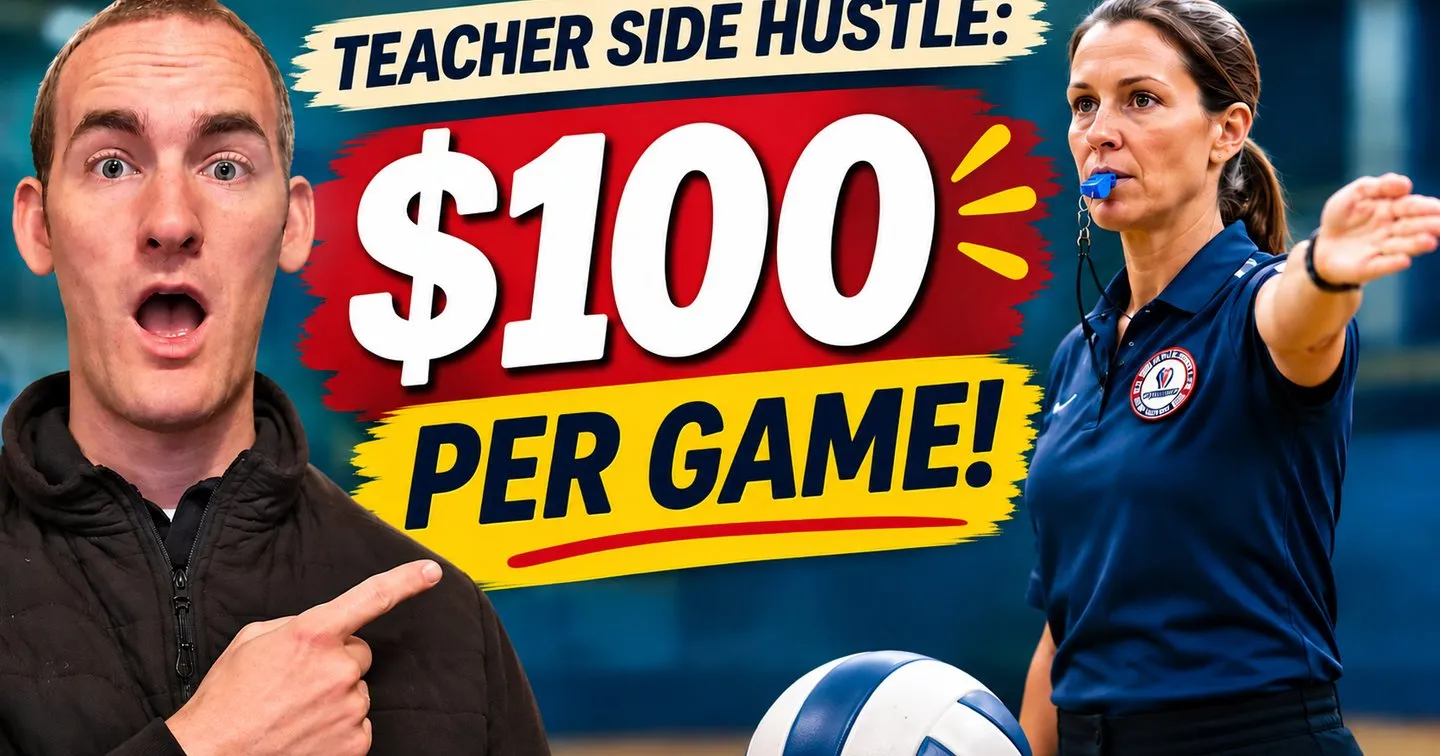
In this episode, I discuss the side hustle of sports officiating with Barb Besal, and how it is ideal for teachers.
There are so many side hustles out there, but some are a better fit for teachers than others, and sports officiating has to be one of the best fits there is. Most sports are played by students, so the job occurs outside of school hours, the pay is decent, and the commitment is flexible. This is an awesome sidehustle for teachers. Listen to the episode to learn more!
Show Notes
Financial Roadmap Strategy Session - Meet me Shaun to become financially confident!
The Teacher's Roadmap to Financial Confidence — a free five-question worksheet for teachers who want greater financial confidence.
Key Ideas
Sports officiating pays pretty well per hour.
Sports officiating fits naturally around a teacher's schedule.
Referees have control over their availability and assignments.
The differences between coaching and officiating, especially when it comes to time commitments.
Teachers can use classroom management skills to become better sports officials.
You’ll want to get in wit h a local sports officiating association and begin getting assignments.
There are additional income opportunities in officiating, including training new referees and assigning games.
Choosing a side hustle you genuinely enjoy can make earning extra income more sustainable.
Bonus Tip
Here is a bonus tip I didn't get to in the episode.
If sports are your passion, this is a great side hustle. If you pair this with running sports camps over the summer like our previous guest Joel, you can make a huge difference in your community and your paycheck!
Transcript
Can Teachers Make Money Sports Officiating? | The Teacher Money ShowThe Teacher Money Show · Teacher Side Hustles
Can Teachers Make Money Sports Officiating?
Interview with Barb Besal · Full Episode Transcript
Introduction: Can Teachers Make Money Sports Officiating?
Shaun Morgan: I'm sorry. It's summer. That's my excuse. Now, here we go. Welcome to The Teacher Money Show, the podcast dedicated to helping teachers navigate your unique financial challenges and unlock your financial superpowers. I'm your host, Shaun Morgan, a full-time educator and personal financial coach and speaker. And I'm here to help every teacher, whether you are a seasoned teacher looking for fresh insights or a new educator navigating your your first paycheck to have a richer wallet, classroom, and life. I am super excited to have Barb Besal back on the show today. For those that have been listening that long, which who knows how many of you that is, Barb was on episode three of our show. And we had a great conversation back then, and we'll get to ask her what's happened since then. But Barb is currently an instructional technology specialist in Virginia Beach, and she's finishing her 20th year in education, 16 of those was as a chemistry teacher and now in ITS. And during that time, and longer, she has been refereeing volleyball. And we're going to get to talk all about that today, as you know, we like to go into these little side tangents on side hustles. And this is just another fun one. Barb, welcome to the show. Sean, thanks for having me back.
Barb Besal: I'm so glad to be here.
Shaun Morgan: So for those that, you know, have listened that long, I'd just love to hear, you know, it's been three years since you've been on the show. What's been happening in your world?
Barb Besal: How is your money journey coming along? Yeah. Well, when I was last on the show, I think I was seeking some counsel because I was preparing to get married. And in those three years, have indeed. My wife and I have been married for a year and a half and money journey is going just fine. I mean, the market's doing what the market does. I'm doing what I do, which is saving as much as I can for retirement. But family expenses are real things. You know, we want to take vacations. We're just talking about possibly buying a new to us car, a used vehicle. So we haven't pulled the trigger on that yet. But, you know, these are real life expenses. Life is coming at me fast and we're having great discussions about it. So I appreciate the counsel that I got from you on the show. And yeah, life is swimming along just fine for now.
Shaun Morgan: Awesome. Well, congratulations. And I'm glad that things are swimming along just fine. Yeah, we're, we're so excited to get to swing back around and talk to you again, because you know, the first It was a great conversation. It was a little bit of counseling, but a lot of back and forth discussion, which was really great. But now we get to talk about something that you're passionate about, something you love doing, and something that helps you make some extra money on the side. And that is sports officiating or refereeing.
Barb Besal: I think they're the same thing, right? Yeah.
How Barb Got Started Officiating Volleyball
Shaun Morgan: And you're doing it for volleyball specifically. So let's just talk about that. What got you into doing that for volleyball?
Barb Besal: So I really started officiating when I was 14, when I was a player in high school. I first picked up a volleyball. And when I started playing club ball, so on the weekends, tournaments, things like that, my team, the way volleyball is structured, there's two playing teams, but there's always a third team that has to serve as the officiating team because there aren't enough professional officials to go around. And so when you're playing in these sort of neighborhood leagues or local club tournaments, there's always a team that's set aside to help work. Thank you. Thank Thank Sometimes that's on our own. Sometimes that's in concert with a professional official. And so my job on the team was to be the referee. We need a lot of officials to work. You need six people to work a volleyball match. An up ref, an R1, a down ref, an R2. You need a couple line judges and then a few people at the table to keep score and show the visual score. And among other things, now we have Libros. We didn't have that when I was a 14-year-old, but a special defensive position that has to be tracked. So there's at least six, maybe even seven people who are needed to referee a volleyball game. And so I always ended up being the one that was up on the stand blowing the whistle in charge of the game. So that was when I was 14. I did that for a couple of years while I was playing club ball. And then when I went to college, I found out that they needed volleyball officials for intramurals at the campus rec center. And so I started working there my freshman year, blowing a whistle as a volleyball. That turned into being an intramural supervisor. So I got involved in other sports as well. Refed some soccer, helped supervise flag football at midnight on the turf instead of studying for the chemistry test I was supposed to study for. That's just what I enjoyed. Choices, choices. But hey, I graduated, so that's fine. And then when I exited college and came back to Virginia Beach to start teaching, I got pulled into officiating for a local officials association. So at this point, I would consider myself like I've become a professional referee. I'm now the person that I would have looked up to as a 14-year-old as being the person on the court who was in charge. So that's really where it started for me. It started as a player experience. I kind of cut my teeth, my whistle teeth on when I was 14 and just kind of I enjoyed it enough that I wanted to keep doing it, made a little money. I it in college. I actually did start reffing high school while I was in college. And then when I moved back, I joined a local association and I've been there for the last 20 years, just like I've been teaching for 20 years.
Shaun Morgan: Yeah, that's awesome. And, you know, I think it's interesting that you just kind of took something that you already had and build a side hustle out of it, right? A lot of people wouldn't think to take their knowledge of a certain sport or any sort of activity and try and build a side hustle out of it. They just think, it's just what I do for fun. But like, you can do something for fun and make money at it at same time in a lot of instances. So I think that that is, that's really cool. Although side note, it's important not to suck all the joy out of it by making it only about money. But that's a different conversation, I think. So you got into refereeing or officiating. Let's use the word officiating. I think officiating is easier to say than refereeing. Yeah, it is. So you're going to say officiating. You got into sports officiating and you're able to keep doing that as a teacher. Why? Why is that possible? Why are you able to do that while you're teaching?
Why Sports Officiating Works for Teachers
Barb Besal: Yeah, so I think there's a lot of things that are natural dovetails between the two professions. As a teacher, a high school teacher, I'm working from 7 a.m. to about 2, 2.30 p.m., and what happens after school? Sports. So that's the next place that I go, especially during high school volleyball season, is I'm generally leaving school, putting on my uniform, and heading straight to a couple of volleyball matches for the evening. So the timing really works pretty well. When it's not high school season, it's club season, and then I'm looking at weekend work. So I'm not having to fight my school day. It's not that I'm occupied during the school day and then can't do my side hustle. My side hustle happens in the hours that I'm not teaching, which is kind of nice. I can make matches that other people can't make because they're working a 9 to 5, so they can't get off of work until 4.30. I can already be there. So when we have matches that start at 330, I'm getting those assignments because I'm already off of work at that point. I guess the slight downside is it is time. You are trading time for that money. So rather than being at home with my family, sometimes on the weekends or in the evenings, I am on a court somewhere blowing a whistle. It's not at all passive income. It is very much active income. But like you said, it's not something that the money is the sole focus. I really love the people that I work with. I love the fact that I get to work with kids a lot of the time, but generally high school age kids, which is the exact age that I'm teaching. It's kind of my bailiwick. So I like working with 15 and 16 year olds. And that's generally who I'm working with during the club season. Like I said, those kids are my crew. They're my work team. So I'm in charge of the match, but they're helping me on the lines or as the down ref or at the scores table. So there have also been natural dovetails there. From classroom management to court management, the two things are so similar. You know, trying to get 15, 16, 17-year-olds to do what you need them to do and to do it well is something I would do in the classroom. It's something I would do on the court, know, trying to bring them along with you. Of course, this is something that they're choosing to be at. They love the sport, but working is not what they came there for. They came to play. They want to be out hitting the volleyball and not blowing a whistle. So I'm still trying to get them to do something that they may not be the most excited about, even though they chose to be at a volleyball tournament. So it's the same as when I'm in the chemistry classroom or at school. You chose to be in this class. You might not want to be here at 720 in the morning, but we're going to make the best out of it. And you're going to do the best that you can, and I'm going to help you with that. So I see them as, you know, part of my team, and that's how I treat them. And I, you know, I back them up and I give them autonomy. And I like. Let them help me out, even when I think I already know what the answer is. And those are all things that I would do in the classroom, too. So being able to, yeah, manage a group of students who are effectively students of the game or students in the classroom. Yeah, the two seem to work right hand in hand.
Shaun Morgan: Yeah, I love that. A few different things that you said I think are really important. Yes, this is actively earned income, not passive income. But, you know, you kind of need active income to make passive income. So especially when we're, you know, in our profession, we aren't able to hit those, you know, massive salaries that we hear about other people hitting in businesses. If you want to juice your retirement funds, if you want to increase those, you know, S&P 500 accounts, whatever, you're going to need to boost up that active income. And this is this is a great way to do that, especially if it's something you love, something your knowledge about. And then I love that, that key piece of like, you have an inside track and a couple of different ways. One, you've got the time during the game because no one is scheduling volleyball games during school. It's just not happening because all the people that are going to play them are in school, right? So the volleyball games are happening outside of school. So you're available, but it's also sometimes happening during that time when other people are not. So you are probably going to get more jobs than those who can't come until after they get off work at five because you are always available then. And then this connection point, I do want to ask you about this. How often are you officiating for students that you actually interact with in your school on a regular basis? Like, are you often with those same students or is it just constant rotating door of different students?
Barb Besal: Yeah, it's different people all the time. For me personally, I sort of recuse myself from the matches that involve my school or school. I work at two schools, so I don't work their matches. It just would be a conflict of interest for me. So I tend to travel to other schools and things like that when it's scholastic season. But when it's club season, yeah, I see those same kids that would be walking around the hallways in my school when they're playing for club teams. So it's a mix of folks. I'll go to a tournament in Maryland or North Carolina or Texas or somewhere during club season and end up working a team that's from Virginia Beach, like from, you know, I'll see kids that I've seen in the high school season like, hey, we know you. So, yeah, it's volleyball specifically is a is a sort of a small community. It's a really tight family. And so when we see folks that we know, it's somehow not surprising.
Shaun Morgan: Well, you know, volleyball is getting much more popular. The largest I think I believe is the largest women's match ever happened just like last year. And it was a volleyball tournament. And it just had like huge. Huge number of spectators there. It's like in Nebraska or something like that of all random places.
Barb Besal: Yeah, they held it in the football stadium. It was that big.
Shaun Morgan: Yeah, but you know, it's growing and it's exciting for anyone who hasn't watched the volleyball game. It's very exciting. I enjoy watching it. But yeah, so you don't necessarily get to hang out with your exec students during the scholastic season, but in that club season, it's a connection point. It makes you a real person, right? And I think that there's something very, very powerful about normalizing you as a person to your students. So you're not just the automaton up there, you know, giving instructions. So when they get to see you in the real world, out there officiating tournaments, there's something really, really powerful about that. So I just wanted to point that connection out. And you can actually, you know, do things, maybe not officiating all the time, but like during those scholastic games, you know, they often need teachers to, to man those things. And if your school is smart, they're going to pay the teachers to do that. I got. I got, you know, paid to collect tickets at the door for basketball games for a school I worked at. And, you know, I got to sit there and watch the kids that I was teaching do something they love so I could talk to them about it. And they said, like, oh, yeah, you know, you got that awesome basket. Like, that was a great shot or whatever. Like, having those connection points where you get to see them doing things and really build that relationship. I think it's just an extra bonus outside of earning money. I love that.
Barb Besal: That's, yeah, I definitely become more of a three-dimensional character to them when they see me outside of school or see me at extracurricular events. I do the same thing. I've done sports announcing at my school for several years in lots of different, like, sports all across seasons or have, like, kept the clock in basketball, stuff like that. So I'm definitely seeing students that way, too. And I think that, like, showing up for kids in that way, it makes a world of difference. You know, it really does. It sort of brings you into... into full focus for them and that they understand that you're there, not just as a teacher, but as, you know, yeah, a full-throated supporter of who they are.
How Much Can Teachers Earn as Sports Officials?
Shaun Morgan: And why not do it in such a way that you're going to get paid at the same time?
Barb Besal: That's all I'm saying, right? Absolutely. A little bit of both.
Shaun Morgan: Just throwing it out there.
Barb Besal: I mean, we have teachers who, when I'm at a volleyball match, they'll be that person who shows up to keep score or something like that. And I let them know if they're doing a good job, hey, you too could come do my job. You could come join my association, be a professional, and go out and make more money at this more than just coming to your own school. You know, you can, on days when your school is away, they're playing somewhere. They might pay you to go to that other school or you can join my association and get assigned. And honestly, it's a little bump in pay. We pay more as an association when they hire out professionals than they do when you're just a teacher showing up. So if you already have the skill set, why not get the paycheck that matches it?
Shaun Morgan: Speaking of pay, I mean, I realize you've got You I Just the Virginia Beach lens. I mean, if you live in Omaha, Nebraska, it might be different. But can you talk about, you know, the type of pay? this a minimum wage type of job or how much are getting paid to officiate?
Barb Besal: It definitely isn't minimum wage. I mean, typically we're paid by the match. And depending on with volleyball, sometimes you're playing best two out of three sets. Sometimes you're playing best three out of five sets. And the pay is usually commensurate with that. So a longer match, a best three out of five is going to pay more than a best two out of three. A higher level, like a varsity match, is going to pay more than something like a JV or a rec league match. So it varies. And if you go on and do college, then that that's going to pay more as well. For me, it's not about the money. But like, so I don't do college because I just don't love reffing adults as much as I love reffing kids. Like I said, 15, 16, 17 year olds. That's that's where my my comfort zone is in terms of managing the. And I like it more when a team's going to win and a team's going to lose, but their salary isn't dependent on that. So among other reasons, that's part of why I just choose not to do college, even though it would be a really nice pay bump. But yeah, so pay is going to be based on the match format and the audience that you're officiating. But in general, I would say my match fees go anywhere from $25 a match, and a match is typically about an hour. If we're playing two out of three, it's probably less, maybe 45 minutes, up to maybe $90 or $100 for a best three out of five match. And that could also last an hour, or it could last two to two and a half hours, depends on how close the match is. So but when you when you break it down, it's definitely not minimum wage. And when I grab students who have, you know, who are on my court as let's say they're, they're working a match with me at a club tournament, and I've got a six. I let them know, hey, you could start doing this, you know, when you're not playing high school, you could come ref rec league ball and come make 25, 30 bucks an hour. And any 16 year old is going, they're going to have dollar signs in their eyes. You know, I mean, it's, that's way better than they would make at a minimum wage job or, you know, in the food service industry or anything. So, and they have the availability and they have the skills, they have the knowledge. So it's a really great starter for young officials for, for young, whether it's students or young teachers who are just getting started. But you, you grow with the sport and the money grows too.
Shaun Morgan: I love that. And just to let you guys know about the pay bump for college. Now this is apples to oranges, but I had a friend whose husband did, was an umpire for, for college baseball. And she said he makes like $800 a game. love Like it's, they paid the umpires very well to go and do those games. And, you that was like college level and, you know, professional, you know, you can get higher and higher and higher. So if you're really passionate about this, it's something to look at as a side. I mean, like if you've got like a minor league, anything in your town or in your area, right? And, know, building up those skills to get up to that space where you're able to, you know, maybe just sub in for the guy who can't come. And then like you, they trust you, right? Like that kind of thing. It's just a slow step up in the process, but like it can be a great side gig because once again, no one's playing baseball at noon, right? It's just, it's not when baseball games are happening. So these are the types of things that, uh, that'll just go hand in glove with, uh, with teaching. So, uh, how much time does this take? And do you feel like it is something that like. A teacher whose teachers are very time conscious, more than another side hustle or side job is going to be more time intensive. You travel a lot, it sounds like. How does that compare to the first of all need to be flexible and second of all to just the amount of time that you're putting into it to do it well?
Scheduling, Travel, Training, and Time Commitment
Barb Besal: Absolutely. So I'll start with just sort of the daily schedule. I get to pick and choose when I'm available. If I have a date that I know I can't make, I block it out and I don't get assigned. So I have pretty full control of when I'm working and when I'm not. I try to make myself more available when I know my assigner will need it. So they have busy days where they're trying to assign a lot of matches. And so I want to make sure that I'm available on those days. So I do make sure that I'm available during like a busy high school season. try to be available at least three nights a week. We also have sometimes Saturday morning matches or things like that at Rec League. I want to make sure that I'm helping out, not just leaving those, because sometimes we use those for evaluations, things like that. And I'm at the point in my career where I'm doing some of the mentoring, some of the evaluating. So I want to make sure I'm available to help our new officials grow as well. But one of the things I really love about officiating is I show up, I work the match, I leave. I don't have after match responsibilities on site. So I don't have to be the one to break down the net or put away the chairs or collect the uniforms or plan practice for the next day or anything. So love coaches. Coaches are great. We need them. I'm so glad that people coach so that I can officiate, but I don't want to be a coach because it is exactly like being a teacher. It's practice planning all the time. It's seeing the same group of kids every day at the same hours every day. And I just don't have the energy for that after having gone through a full day at school. So I can show up, do my job. And say goodbye. And then the next day I'll go see a different team or I'll be at home and I'll wait another day before I go see, you know, another group of teams. I just, I like the constant change of it. I don't mind traveling to different places. In my area, we have 11 high schools, so I can go lots of different places. I know some folks have to travel probably a lot more to get to two or three high schools. But in my area, I can travel to 11 different schools within about 30 minutes. And that's way closer than traveling to any college or anything like that. I'd rather travel 10 minutes up the road to work two varsity matches and make a reasonable paycheck in a night than travel three hours each way for one college match. So the time to money ratio to me is pretty good. And I also, so you asked about, you know, preparation, professionalism, training, things like that. We definitely have a fair amount of training we have to do. Our training usually happens prior to each season beginning. So in high school season, I'm doing clinics from late July to mid-August, about three or four weeks worth of clinics. I also happen to be, with my teaching background and my knowledge of the rules, I tend to be the primary clinician. I tend to be the one giving those clinics instead of the one sitting through the classes. And I get compensated for that. My volleyball commissioner makes sure that I am paid for my time, and I really appreciate that. So I try to put together the best product that I can. And people generally seem to like what they receive when they come to one of my clinics. I've had people tell me that I should bottle and sell or package it up and sell it off to other associations. And I've thought about that. I haven't gone down that route yet. But that could be another sort of adjacent side hustle is not just doing the actual refereeing, but helping to train the folks that are out there who are trying to learn. So that's one of The skill sets that I've built as a teacher, learning technology, learning how to present information in a way that is clear to the recipients, and creating small engaging activities, kind of the way you would in your classroom. I try not to give them death by PowerPoint, but rather get them up and doing card sorts or having discussions, doing the sorts of things that get your students thinking in your classroom. That's the same thing that's going to get referees thinking about what they need to prepare for for the season. So I definitely put in a fair amount of time training. With volleyball, it just so happens that we have a high school season, we have a club season, we have a college season, and with each of those, at each different level that you decide to officiate, you may have one or more professional associations that you have to join and become a part of and do training for. So it can be time intensive, and with volleyball, and I'm sure there's a lot of other sports that are like this as well, there's different rule sets. So high school doesn't operate under the... The same rules that college operates under that club operates under. So you have to constantly shift which rule set are we playing with today? Which rule set are we training under today? And it takes a lot of mental switching. But again, as a teacher, I feel like I do that all the time. I'm constantly making decisions, constantly trying to decide, you know, what's the best choice of going forward under today's rules? Are we operating under an adjusted schedule today, you know, or is it a regular day? Things like that. So I feel primed to handle those sorts of things as a classroom teacher. Awesome.
How to Become a Sports Official
Shaun Morgan: Everyone, you heard here first, volleyballofficiatorclinicals.com or something like that. Patent pending or trademark pending. Yeah, that's great. So like you just, once again, it goes very well together. You have the training, the skills, all that stuff necessary. It just takes, you know, getting that approval from. An association to say, yes, you can do this and then go out and do it well. And you will be able to be very successful on that. So just got a few more questions for you as we're wrapping up here. If someone wants to become an official, what's the first step they should take?
Barb Besal: Well, I always find that it helps if you've played the sport before. It's not a prerequisite. We have a lot of volleyball officials in my association who came over as transplants from softball or basketball or something else. But when you have some knowledge of the sport, it goes a long way. I started as a player and I was not the best player by any stretch. I never started games. But I was always in attendance, paying attention, learning the game. So the first thing to do is just become a student of the game, whether you're a player or a spectator or something, and just kind of get to know some of the basic terminology and how the game works. The next thing to do would be to find a local connection that could be. An association, usually some group of umpires, officials, referees in your area, and reach out to those people or that person. So hopefully they have a web presence or, you know, if you attend a match, walk up to the official and say, hey, I'm interested in doing this. Who can I contact? That's honestly probably the best way to go. Most of us are busy officiating and don't have a ton of time to maintain a website or as much as my, you know, a signer wants to monitor emails for things like new referee interest. Usually they're monitoring emails for last minute match changes and people backing out and having to do sort of the daily maintenance of just handling a season schedule. So walking up to an official and saying, hey, I'd like to do this. Who can I contact? That's probably one of the best ways that you can be put in touch with someone. So yeah, those two things I would say are really big. Become a student of the game. Start to learn it through different lenses. Maybe you come from a coaching perspective, refereeing is completely different. So next time you're at a tournament or at a game, try picking up a whistle, try taking the place of one of those kids and seeing if you can call lines or, you know, seeing if you can manage the fans who want to shout at you, you know, do you have a thick enough skin, those kinds of things. And then reach out to your local association or find a professional organization that you can inquire about when you might start. I know one of our challenges with volleyball is we try to onboard folks right before the high school season, which in Virginia we play in the fall. And so we get folks who reach out in January or February and we say, that's great. We're so glad you're excited to join us. We have to wait until July. So if you find yourself with some downtime when you reach out and they say, I'm sorry, we're not onboarding just yet. Don't lose focus. Don't put a note in your calendar to reach back out later on, you know, and don't just say, well, I can't do it today. Therefore, it's not an option. This is something that can really pay off if you just can get past the, don't get it today, or I don't have that instant gratification. Sometimes you got to wait a little bit, but then you have more opportunity to go watch matches, go watch games, and go learn a little bit more about the sport before you enter it from the officiating side.
Other Opportunities and Barb’s Final Advice
Shaun Morgan: Yeah, I love it. Those are great pieces of advice as people are thinking about getting started, joining the side hustle. I am curious. The assigner doesn't sound like a full-time job either. That might also be a side hustle that someone could take on. If you're really good at organizing things and you want to put things this way, that way, something else to consider. Like, hey, if you're talking to this association or if you are officiating, you could look into talking to your association about taking on that role of being an assigner.
Barb Besal: 100%. Our assigners typically have full-time jobs doing something else. A lot of them are in education, if you can imagine that. And they are, like I said, managing the conversation with athletics directors, activity coordinators at schools, principals, things like that. They're handling schedule changes. They're handling a cadre of possibly 100 or more referees, managing their individual schedules, assigning matches, and then also handling sometimes the business contract side of things. So when our contracts come up, they negotiate for increases in pay or other administrative things that I don't have to think about as an official, but it takes a really special skill set to do those. And again, a lot of them happen to come from education. And sometimes it's something that's split up over multiple people. If there are lots of folks to assign, we might have two or three assigners. I know one of our assigners had his wife sort of work as a secretary for him because there was just so many emails. He is a baseball commissioner, and there were so many rainouts and so many schedule changes that he needed Did more than just himself monitoring emails and making those assignments. So he was able to help pay his wife to do the job as well. So, yeah, there's definitely opportunity in logistical concerns when it comes to refereeing, not just managing the rules and blowing a whistle.
Shaun Morgan: Yeah, so if you don't want to get yelled at by parents, this might be another opportunity. That's what I'm saying. Not saying it will absolve you from yelling, but there always seems to be somebody who's got an opinion somewhere.
Barb Besal: But, yeah, you won't get it shouted in your ear by a parent, that's for sure.
Shaun Morgan: All right, awesome. Well, Barb, this has been a really fun conversation. I have really enjoyed talking to you about this. You know, if someone has a question about officiating or they want to, you know, ask you more questions about your story or anything like that, is there a way that teachers can get in contact with you?
Barb Besal: Yeah, best way to get in touch with me is over email. My email is barbbesal, B-A-R-B-B-E-S-A-L at gmail.com.
Shaun Morgan: No, it's great when you can get just your name instead of having to fight with other people for numbers and all those other things. Yeah, thank you so much for being willing to share that. And feel free to reach out to Barb. She responds. She's way better at responding than I am. So it's great. And my final question for you today, Barb, is what is your number one tip for teachers to have a richer wallet classroom in life?
Barb Besal: Oh, it's so simple, Shaun. Do what you love. I love teaching and I love volleyball officiating. And that's why I've been doing them both for 20 plus years. And the day I don't love it will be the day I stop doing it. But that day hasn't arrived yet.
Shaun Morgan: I love it. That's just a way to kind of encapsulate all of those things, right? If you're loving it, you'll make money. If you're loving it, your classroom will be better. If you're loving it, your life will be better. It all comes together. It's a beautiful, beautiful thing. Thank you so much for coming on the show today, Barb. It's been a ton of fun.
Barb Besal: Thank you, Shaun.
Shaun’s Key Takeaways
Shaun Morgan: Wow. Wasn't that a great episode? Thank you, Barb, so much for coming on the show. Now it's time for my top tips, my key takeaways here, my cliff notes for this episode. The first one is you can make some good money by officiating. It's not minimum wage. And when you look at the stipends that are getting paid out for the things that we do for our own school, that might be less than a minimum wage. So this is a much better way to make money if that's what you really, really need. Number two, it's a way to connect with students as a three-dimensional person. Not that you get to spend all the time with your students, like coaching is a great way to actually connect with your students, but this is a great way to be out in the community, out in a place that they're going to see you and see you as a human being. So that way you are more real to them when you interact with them at school. Number three, you get to pick and choose. Choose your schedule. It's flexible. You don't have to get locked in on I'm officiating every night this week because I'm an officiator. You get to choose however many nights per week you're available. And if you have nothing else to do, stack up that schedule. If you only have availability here and there, just let your assigner know that and you can give that flexibility to your schedule. Number four, coaching is way harder than officiating. I loved her point. Coaching is not just the coach, but also the plan, the person that's going to set up and take down and yada, yada, yada. There's so much extra that goes into coaching. I would personally officiate over coaching because coaching is so much more difficult and so much more time consuming. However, there are many life benefits to coaching and classroom benefits to coaching beyond the monetary ones. So if you are coaching because you just love it or you're coaching because it connects you with your students in a powerful, meaningful way. That is a great way to be a coach. Number five, just remember that this isn't like, oh, I'll just go do this. It does take training. You have to know the rules. You do have to join associations to be able to get that pay that you want and to have those negotiated contracts to get those assigned games, et cetera. So there is some work that goes into it. But the amount of training that goes into officiating and getting there to get that pay bump is definitely worth it. Number six, I think this was my favorite phrase from the episode, become a student of the game. Now, I think that this is not just about officiating. Become a student of the game was what her step was to get started. Make sure you really understand the game. Make sure you are studying it. For any side hustle that you want to do, become a student of the game. Make sure that you are studying it before you just dive in. Make sure you understand what you're doing. Make sure you understand know the ins and outs, the why behind things. So that way when you encounter a problem, you know what to do. You know why that's the right step and you're able to overcome that problem and move forward. Become a student of the game. And lastly, do what you love. If you love officiating, if you love coaching, if you love assigning people, whatever it is you love, if something like that just makes you happy or you enjoy the challenge or whatever it is, do what you love so that way you are fired up and continue doing it. These things will lead to a richer wallet classroom and life. But remember, as a teacher, you are already rich. Your wallet just needs to catch up.
The Teacher Money Show · Helping teachers build wealth while remaining teachers.